To create a ‘Menu’ is the focus of this work; such that, we have observed the only way to make this Menu is to teach the reader what an ‘Ingredient’ is, and how such an Ingredient is ‘Cooked’. This is an academic text {as such, it is a long and deep read requiring your undivided attention}; such that, it gives you the formulas for computation; it is noted that one is counseled NOT to ‘try this at home’; the process of determining the events herein are one of a team effort - where {given the matter under calculation} the respective Jackalope officer assists you. Extensive consideration has been given to the economic plight of the consumer <our audience / the reader>; such that, we regard the formulas (and methodologies) hereof to be for the express purpose of ‘Maximizing Utility’ {both yours and ours}.
As we ponder and consider the nature of your proposed construction process, we observe a near reverse order - which is not to suggest the ‘Normal’ order is somehow better. Here the promo video proposed is advanced to the 1st position - where it is “Normal[ly]” {and, I use this word loosely} at (or towards) the end of asset creation. This is a fundamental causative nature - which is precisely the difference between a game’s promo detail and the lack of detail in the game; in few specific instances <After Earth>, the game’s promo has limited (or zero) representation in the game; such that, the promo behaves like a movie advertisement - which leaves the watcher dissatisfied with the movie having created expectations unmet.
Again - as one considers this Normal status-quo: The production of a promo video in a latter position, as opposed to 1st here, is illustrated {by reality} to present negative consequences. Therefore, it is reasonable to observe positive attributes do exist, in doing the promo video first.
In this Normal production process, perhaps it is an entity’s poor comprehension of financial structures {in conjunction with poor design concept from the beginning} that perpetuates this Normal environment. In our stated methodologies / functionalities (and possessed / professed abilities), Jackalope is to be - in such a position - as to be able to comprehend {more} fully ANY a financial structure, and we are to - from conception - conceive (and produce within) a more Utility Maximizing design concept.
EQUATION
Cost (or ‘Price’ per ‘Job’) is equal to the ‘Concept Art’ < “CA”> - which is a function itself - plus other events - which are equal to zero (0) until CA is complete {See “Rule #3” for clarification, below}.
Pj {“j” | j ≥ 1, & j = ‘Job’};
∴, 1st assignment = Promo Video;
P₁ = CA + 3D(0) + Unwrap(0) + Texture(0) + Rig(0) + Animate(0) + Render(0).
2nd assignment = Low-Level Gaming;
P₂ = P₁ + GDD(0) + Asset Management(0) + Programming(0) + In[&Ex]ternal Testing(0).
It is incumbent upon the writer hereof (and it is equally prudent) the formation of the equations be explained thoroughly. Indeed, this is a Jackalope intellectual property; however, the performance of the equation is beyond {simply} the knowledge thereof; in this way, the reader’s experience with the equation is similar / equivalent to dieting; such that, many individuals know the appropriate methods by which one: Diets, Manages Portions, Eats Natural Foods, and/or Exercises. Indeed the paradigm: Individuals are aware of the most appropriate ways to lose weight, but the act of knowing (and being aware) is NOT what sheds the pounds, of fat; it is the performance / execution of the knowledge - where the motives are correct / proper {not manipulating to others or self} and not deferring in happiness, as one is to have happiness in all things.
We set before you, at your ‘Dining’ table {to encourage a most excellent Dining experience - which is a function of atmosphere, lighting, sound, temperature, and - of course - that which you taste}, a ‘low-fat’ Menu; such that, this Menu is an 11” x 17” tabloid print. The quality of low-fat is a metaphor illustrating the absence (or the least amount) of ‘Waste’ - where Waste is the misuse of time and money {such a shame is Waste}.
What is “CA”?
CA is a composition of ‘Labor-Hours’ <“Lhr”> and ‘Edits’ <“Ed”> - where Edits <a unit of measurement> are a function of Labor-Hours, and CA <per job> is defined by the ‘Examples’ <“Ex”> provided; such that, these Examples (and the combinations thereof) are the basis of how this initial Price is determined; thus:
Examples {At present, this is the best operational methodology!}:
Labor-Hour <the Cost-Driver, “Lhr”> and Artistic Creative Licenses <“ACL”> {due the laborer - which is the artist}
increases as the client goes down this list. And - consequently, our expectation of any a client
having units of edits <“Ed”> increases {thusly}, in conjunction. In this way, CA illustrates itself to be a
function of parts / elements causing said “composition”: Labor-Hours + allotted Number of Edits.
Lhr = $___0.00
{refer to Pricing Chart; such that, this is a discounted price}
Ed = 4●(Lhr)
Exact {Least ACL}: [10●(Lhr) + ½●(Ed) = 12●(Lhr)]
Owned IP, of the proposed client:
As we’re examining Concept Art, this is - most generally - photography (or an otherwise ‘Captured’ image),
Occasionally, the client provides its ‘Self’ {for digitization / scanning}, its statutes, its structures, its paintings, and other like Owned IP,
In limited - very specific - instances, CA = 2●(Lhr); such that, the Client provides us ALL CA - where this provision is subject to CVIA agreeing the supplied materials are adequate for the next aspect / element of production {in general, this is the migration to 3D modeling / sculpting};
Public Domain w/o restriction:
Occasionally, the client provides action figures / MRI or CT scans (and X-Rays with and without Contrast not violating the provisions of HIPPA) / statues / paintings / blue prints and the like,
In limited - very specific - instances, CA = 2●(Lhr); such that, the Client provides us ALL CA - where this provision is subject to CVIA agreeing the supplied materials are adequate for the next aspect / element of production {in general, this is the migration to 3D modeling / sculpting};
Public Domain w/ restriction:
Historic Art & Artifacts:
Jackalope reserves the right to require ‘Indemnity’, in writing, before asset constructed from CA is rendered - which is before release;
IP of some other entity {many restrictions}:
IP of some other entity to be modified per instruction; such that, Weird Al is an example;
Indemnity required, in writing, before asset constructed from CA is rendered - which is before release.
Approximate: [15●(Lhr) + 2●(Ed) = 23●(Lhr)]
Using the attributes of “Ex:1” <above>, the client proposes the creation of CA with an approximate statement of, “Design for me / us something like...”;
‘This’ + ‘This’ = “That”: [20●(Lhr) + 3●(Ed) = 32●(Lhr)]
“That” is without a representation directly;
In this approach, the client has an idea, but is unable represent it specifically (i.e. “Directly”); instead, the client says - approximately: “Hey, make me something that is part this and part this, and it looks like (and behaves like) this...”; such that, the approach is ‘Indirect’ - where the laborer is approaching the “That” sideways - which is subjective (and it is this “subjective[ness]” that requires the allotted three units of “Ed”).
A Discussion {Most ACL}: [30●(Lhr) + 4●(Ed) = 46●(Lhr)]
This process is highly textual and vocal {one of notes submitted and taken - where recordings of conversations (and the transcription thereof) are paramount in maintaining continuity and focus}, as attributes of “Ex:3” <above> are limited or unavailable, for we are in the realm of ‘Imagination’.
Of course, the CA is also a ‘Combination’, of the above; as such, the equation for CA is more exactly described by the following - where, at the CVIA’s discretion {in any given “ß” chunk}, the “Ex” defaults to the higher quantity hour position in situations of Combination, as there is no other observed reasonable accounting method available; hence, no “&” {just the “or”}:
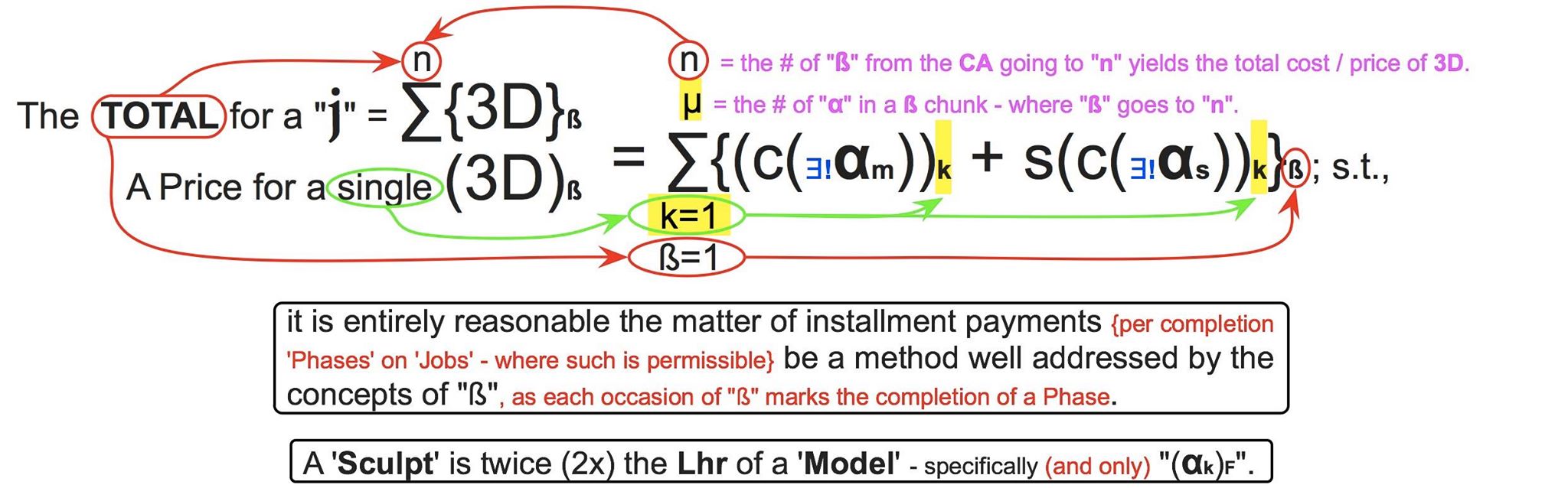
“ß” ≥ 1 and goes to “n” - where the size of “n” is determined by the CVIA. A ‘Storyboard’ has “ß” chunks.
“ß” is the occasion of ‘ßeta’ - which, as in programming, is to symbolize a test version {Such is a Storyboard, yes? True!}.
“Skeleton & Bucket*”: The Storyboard process {in general} is one that involves aspects of each “Ex”, to one degree or another. Additionally, there is a very good ground-rule to have well established:
* Benjamin’s word visual from our phone
conference 9/2/13 @ 6pm EST
RULE # 1: It is reasonable (and appropriate) for additional edits {beyond that which is aforementioned and allotted} be billable separately; every effort is afforded to keep the costs - to the client - at a minimum - which is the excruciating detail herein. It is {therefore} the recommendation of Jackalope, as we desire to have the fewest number of editing sessions (and the maximum number of labor hours available for our other considerations): You <the Client> are to be as thorough Mentally, Textually, and Physically as you are capable, as it is in the financial mitigative interest of the YOU to do so.
NOTE {on Ru:1.a}: Jackalope bares the responsibility of getting the number of Labor-Hours correct. Where Jackalope artists have labor-hours beyond the aforementioned “Ex:Lhr”, those hours are the responsibility of Jackalope, and the costs are not passed-on to the client. This is quite the opposite the matter of Edits, as the client determines the number of Edits - which is an aspect of the reasoning for the existence of the unit of measurement ‘Edit’.
Proper (and appropriate) CA yield the most accurate calculation of 3D ‘Assets’; such that - as Natsume reminds: “Every ‘Space’ - within the 3D construct - filled by an architecture is an Asset”, the “n” of (Ex)ß gives us an idea of the minimum number {such that, we’re looking at the total number} of Assets <“α”> {not the total per “ß”}, and it is a “minimum” in that the “ß” chunks {per ‘Job’} themselves - more than occasionally - contain some number “α”, of Assets, greater than one (“>1”); therefore,
Each “ß” contains at least one “α”; s.t., α ≥ 1.
RULE # 2: There is no 3D in CA; “α” are constructed from a well conceived CA.
RULE # 3: There is no 3D production until the CA is finalized - which is why its value is zero until CA is complete.
RULE # 4: The respective counting ‘Quantities’ for each follow this “α” ≥ “ß” = “nj”.
What is “3D”?
With CA clearly determined - where consideration for ‘Feature-Creep’ is given, and - as coding commences - the foundation is robust and capable of additional features), the estimation of “α” (and the construction thereof) begins. Just as “Ex” had four (4) unique qualities defining how the parameters for CA are determined, the “α” of 3D comes in - at least - two (2) forms {‘Sculpt’ & ‘Model’}; such that, each α-form <“k”> has a maximum of three positions, on the ‘Level of Detail’ < “LoD”> - which determine detail {the number of Polys}:
Models <“m”> Only*
* = No units of “Ed” are estimated here below for the very reason
that the CA is to be a complete representation for Asset build.
As a unit of “Ed” is requested, it is billed separately; such that,
a half unit is the minimum available for purchase & / or billing.
Foreground { most detailed = ↑ Poly; s.t., an “αk” having a “c > 1” starts in the highest Polyform down }: [“(αk|m)F” = 20●(Lhr) + (0)Ed*]
cF = 1 ; s.t., c(αk|m)F = 20●(Lhr),
cF+M = 1.5 ; s.t., c(αk|m)F+M = 30●(Lhr),
cF+M+B = 1.75 ; s.t., c(αk|m)F+M+B = 35●(Lhr),
Mid-ground: [ “(αk|m)M” = 10●Lhr + (0)Ed*]
cM = 1 ; s.t., c(αk|m)M = 10●(Lhr),
cM+B = 1.5 ; s.t., c(αk|m)M+B = 15●(Lhr),
Background { least detail = ↓ Poly }: [“(αk|m)B” = 5●Lhr + (0)Ed*]
cB = 1 ; s.t., c(αk|m)B = 5●(Lhr);
s.t., an alpha “k” given “m” in the position of “c” singularly <“α(k|m)c”> is representing a “k” Asset having different LoD phases - which applies to gaming {not promo videos}, and “c” denotes ‘Coefficient’ position:
1 = F,M, or B ONLY,
1.5 = (F+M) or (M+B), or
1.75 = F+M+B.
NOTE {the math here is implicit}: Poly’s - having a multi-LoD presence - start at their highest form.
Sculpts <“s”> Only*
* = No units of “Ed” are estimated here below for the very reason
that the CA is to be a complete representation for Asset build.
As a unit of “E” is requested, it is billed separately; such that,
a half unit is the minimum available for purchase & / or billing.
Foreground {An “αk” having a “c > 1” starts in the highest Polyform down - where in ‘Sculpts’ there is only ‘Foreground’}: [“(αk|s)F” = 40●Lhr + (0)Ed*]
s•cF = 1 ; s.t., c(αk|s) = 2(20) ➪ 40●(Lhr),
s•cF+M = 1.5 ; s.t., c(αk|s) = 2(30) ➪ 60●(Lhr), &
s•cF+M+B = 1.75 ; s.t., c(αk|s) = 2(35) ➪ 70●(Lhr).
NOW: As each subsequent “ß” chunk - in the CA - is produced, it has the ability to contain “(αk|m/s)”; such that, the “α” is already built; this brings about the use of the ‘Theorem of Uniqueness’:
That which is not a ‘Copy’ (and that which is original having never existed before) is ‘Unique’, and anything that is a ‘Copy’ can only be a Copy of something Unique; such that, there exists one and only one “αk” per “j”, and this is defined by “∃!”.
RULE # 5: As “ß” chunks go from one (1) to “n” (and “∃!αk” is in a previous “ß” chunk), the “αk” is not rebuilt / recharged in the proceeding “ß” chunk, each unique “αk” is reused.
That stipulated: A “ß” containing an (αk|m/s)F whose coefficient is “1” {such that, a subsequent “ß” - form the CA - is observed as having the “M” &/or “B” form}, the “F” is built in the initial “ß” and the lower forms are built in a latter “ß”.
However, a “ß” containing an “(αk,m/s)M or B” {such that, a subsequent “ß” - form the CA - is observed as having the “F” &/or “M” higher Poly forms}, the “F” &/or “M” is built in it’s highest “ß” requiring form during the initial “ß” in which the “(αk,m/s)M or B” presents itself; such that, the latter “ß” already has the “∃!α” built. This does result in the earlier “ßs” having higher installment costs; however -proportionally (and respectively), it decreases the cost of subsequent ßetas, as “ß” goes to “n”.
RULE # 6: Where possible, Jackalope examines - with the express assistance of the client - the nature of “α” being readily available for download {having ‘DRM-Free’ status} or purchase {having ‘DRM-Free’ or unrestricted licensing}; such that, the ‘3D Packets’ are able to be utilized ‘As-Is’ (or be slightly modified - subject to any license agreements associated thereto). The CA tells us about the usefulness (or lack thereof) of any a Packet, as the matters of consistency regarding ‘Lighting’, ‘Shading’, ‘Theme’, and ‘Style’ {to name a few} are highly restrictive and limit the use (and availability) of Packets.
RULE # 7: An “α” is either a Model or a Sculpt; it is NOT both. A Sculpt is twice (2x) the Lhr of a Model - specifically (and only) “(αk)F”.
NOTE <Ru:7.a>: It is inefficient (and preposterous) to employ / allocate the resources of Sculpt[ing] in making Mid and Background “α”.
∀ “ß” - in a given “j”, an (αk|m) ≠ (αk|s); s.t.,
a “j” here is a single ‘Concept’ or the ‘Dynasty’ of said Concept.
“c” is a descriptor that gives “αk” its value in Labor-Hours - given an “F”, “M”, &/or “B” position.
“s=2”, at this juncture, as such is at Jackalope’s discretion to change, is the determiner which limits the permutation of an “αk” to “F”, per “Ru:7.a”.
Some “α” are more detailed than other “α”; some “α” are:
‘Characters’: Some have ‘Closeups’ and others do not; such that, the ones that are not Closeups do not require the same level of detail as those main Characters;
‘Environments’ include ‘Static’ terrain having a Fore, Mid, and Background subject matters - whether landscapes or cityscapes or inside a room-scapes; these require attention to detail like that associated with the Characters;
‘Interactive Objects’ that are manipulated by an “α” {such that, they are ‘Dynamic’ - not Static} require special consideration and are usually highly detailed, and it is necessary to consider exactly “HOW” the Object is experienced by the Character(s) and viewed by the end-user; such that, the computer running the experience is able to do so without ‘Lag’ / Problems.
Storyboarding correctly {though the CA} permits discussions on - for instance - trees always being twenty feet (20’) away - which permits the detail <the number of Polys> to be kept low. And - where the tree is experienced in the distance, it is a candidate for a ‘2D-Billboard’ moving with the character leaving only one side of construction viewable; this {too} keeps the work on the processor to a minimum. A well envisioned CA gives its holders a checklist of phenomenal value.
So for each “α”:
Next: We address the matters the matters / formulas of...
‘Unwrapping’ + ‘Texturing’ + ‘Rigging’ + ‘Animating’ + ‘Render’. As stated, at the beginning:
“Cost (or ‘Price’ per ‘Job’) is equal to the ‘Concept Art’ < “CA”> - which is a function itself - plus other events - which are equal to zero (0) until CA is complete {See “Rule #3” for clarification, below}.
Pj {“j” | j ≥ 1, & j = ‘Job’};
∴, 1st assignment =Promo Video;
P₁ = CA + 3D(0) + Unwrap(0) + Texture(0) + Rig(0) + Animate(0) + Render(0).”
As we have analyzed herein, the more current representation of the formula is thus:
LG
Edited by: Natsume & Thomas
--
,/ \.
|( )| _ ______
\`-._: \ / ;_,-'/ | |____ |
`.__ \ )_( / __,' | | __| |
'.' '.' Kind Regards _ | | |__ |
|o o| Lawrence @ | |__| |____| |
{= Y =} \____/|______|
'-.^.-'
Herein we continue with the phase of ‘Unwrap’. ∆ = Image is to be “changed”.
∆ A sample female form… ∆ One side of a symmetrical clothing set.
∆ Male form unwrapped…
Unwrapping is respective to each “αk” and its position of “LoD”. ***NOTES***
this is a labor intensive task - which prepares for the phase of texturing; such that, it is imperative the individual unwrapping (and the individual texturing - where not the same person) communicate precisely what one is expecting from the other; such that, all the work of unwrapping and texturing refers to the CA.
The Fore to the Mid loses polys - which cause warping … so each “αk” is to be unwrapped separately...
note the video promo only has ONE position, and the video game has multiple… address this topic above...
6:36pm
Facial Rigging and facial animation are on the same level as regular rigging and animation respectively, but completely billed separate - they are not required on all rigged/animated models, and are a whole other body as far a time spent rigging/animating.